- Published on
Why Businesses are Hiring Freelancers Instead of Full-Time Employees
- Author
- MrSolvo Team
Whether it's industry-changing collaboration models and the debate over freelancers vs full-time employees it's now a discussion matter for a wide range of industries, and not just for HR professionals anymore.
This change reflects the manner of competition in the industry and how platforms like MrSolvo contribute in finding expert freelancers.
Hiring Costs
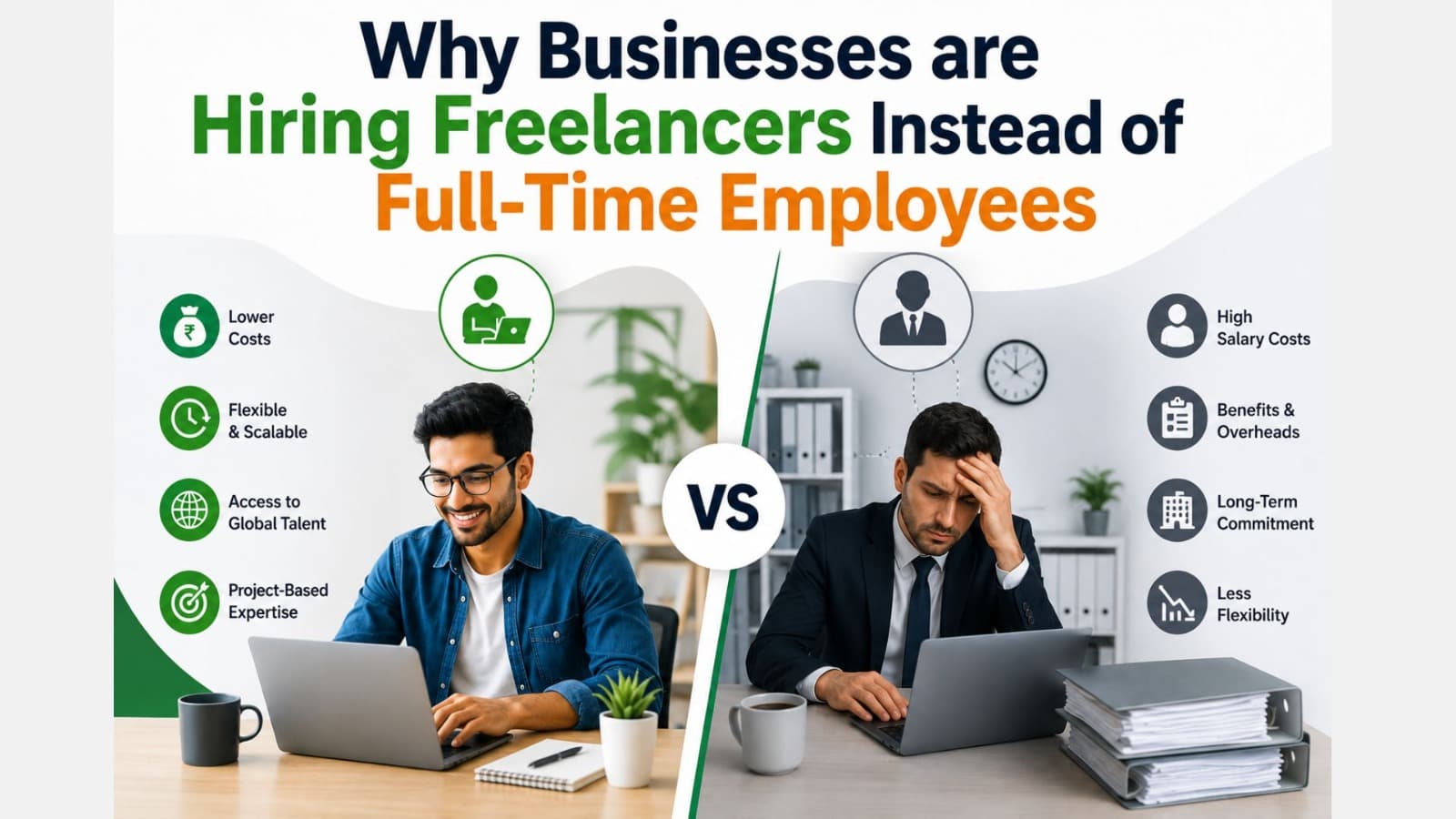
Money is one of the top reasons for this change. The costs of hiring freelancers from MrSolvo are often much less than hiring a full-time employee.
Full-time hire will include:
- Health insurance and benefits
- The employer is responsible for paying payroll taxes and workers' compensation.
- Leave entitlements
- Office Space, Equipment and Software Licenses.
Freelancers are, however, typically paid only for the work they deliver. The economic overheads at the end of a project are minimal, there is no financial obligation to tie up, and no benefits package to control at the end of the project. This helps many companies, particularly businesses of medium or small size, manage expenses.
Small companies are also finding they don't need to hire full-time staff to achieve the specialist knowledge a new hire might need, and candidates are more inclined to offer their services as freelancers than to apply for a formal position.
Why Freelancers are Hired
Although savings is a primary attraction, the benefits of hiring freelances are far beyond just bottom-line effects.
Freelancers from MrSolvo often have access to a specialized expertise which may take a number of years to create in-house for a company. An expert can be hired for a business that requires it just a single time to redesign the app or just a marketing push for a short-term period without the business having to train its employee to start it all over again.
Hiring and onboarding can take weeks or months in traditional hiring processes from posting jobs until interviews and background checks. From making their way through freelance platforms and networks, businesses can discover—and contract—qualified expertise in days, in some cases, hours.
Fewer management overheads as freelancers are self-directed. They don't benefit from the same level of management scrutiny, performance appraisals or career pathing as those who work full-time do, and that means that managers can concentrate on key business issues.
It now isn't restricted to hiring someone from within a commuting distance, or even within their own country. Freelancing permits organizations access to a truly Global pool of talent.
Gig Economy’s Hiring Impact
Trends of Gig Economy reflects an independent workforce with its preference for flexible working hours and control over the projects they pursue. Millions of skilled professionals today opt for freelance work, seeing it as a major job instead of a side hustle, be it a freelance software developer, graphic designer or copywriter.
As a result of this change in the workers' preference, companies have had to re-think their approach to hiring. Many companies are now not only using freelance workers as a bridge to regular staffing, but are creating all parts of their operation around a combination of both.
The platforms linking businesses to vetted freelancers have come a long way from just coordinating marketing campaigns to facilitating access to the most reliable high-quality talent for support and on-going engagements—especially for short-term projects.
This has taken a boost from the adoption of remote work. When people found out they could get productivity out of evenly spread-out teams, the steps to employing the services of freelance people in various time zones were a lot smaller.
Maintaining Agility amidst Workforce Flexibility
Flexible workforce appears to be maybe probably the most strategic reason why enterprises are making use of freelance talent. Business demands fluctuate. During a product release, a company might require more of one type of design help, when it has to introduce into the market a big number of downloads, additions or content writers during a marketing campaign, and then much less support when marketing ends.
Those who work full-time are a fixed cost. Changes of number and composition of permanent staff members are time-consuming, costly, and may cause culture changes. Freelancing can help companies to ramp up and ramp down when they need to, rather than navigate recruitment freeze cycles and layoffs.
Especially during times of economic uncertainty, this flexibility has been beneficial and useful. Hiring freelance employees gives businesses the flexibility to quickly scale up or down their rewards and advantages contingent upon market changes, while also avoiding the potential liability of permanent workers.
When to Hire a Freelancer vs a Full-Time Employee
Freelancers are no alternative, however, to all jobs. It depends on the kind of work to determine when to hire a freelancer versus full-time employee.
Freelancers are the most suitable when:
- The project has an identified scope/closure date
- Niche skills or specialised skills needed that are not required for the future
- Alternate coursework is available throughout the year specifically suitable for the given season
- Flexibility in the budget is more significant than do long-term stability
Full-time employees make sense when:
- Fragmentation may result in the loss of a deep ongoing institutional knowledge.
- Regular collaboration and company culture are vital is key.
- The opportunity plays a key role in Company's future development projects
- The availability and accountability of children are key factors to consider.
There are businesses in the world today that implement the successful business model that is not one or the other. Rather, they take advantage of all the benefits of a stable workforce and the flexibility of freelance employees by utilizing them in the most appropriate manner.
Final Thoughts
The debate between freelancers vs. full-time employees isn't a goal of having one model outcompete the other. It's recognizing that there are various types of work, and various types of talent solutions.
Freelance services offered by MrSolvo is integral to the way companies do business today, as it affords them lower costs, access to a talent pool of specialists, quick hiring, and flexibility.